Who Has Won the African Player of the Year Award Since 1970?
The African Player of the Year award, currently administered by the Confederation of African Football (CAF), recognizes the top-performing footballer from the African continent. As of 2026, the record for the most wins in the men's category is shared by Samuel Eto'o and Yaya Touré with four awards each. In the women's category, Asisat Oshoala holds the overall record with six wins. The most recent men's winners include Achraf Hakimi (2025) and Ademola Lookman (2024).
Tracking the history of the African Player of the Year award offers a fascinating lens into the evolution of global football. From the early days when domestic-based stars dominated the voting, to the modern era where African talent drives the success of Europe's elite clubs, this accolade highlights the continent's profound impact on the sport.
This comprehensive overview breaks down the complete list of winners from 1970 to 2026, analyzes the statistical trends behind the voting, and explores the historical shifts that have shaped one of football's most prestigious individual honors.
Who Are the Current African Player of the Year Winners?
The landscape of African football is highly competitive, with recent award cycles reflecting a diverse range of talent across different European leagues. The most recent awards highlight players who have achieved significant club success alongside strong international performances.
For the 2025 cycle, Moroccan right-back Achraf Hakimi secured the men's award. His victory was heavily influenced by his pivotal role in Paris Saint-Germain's historic domestic treble, where the club secured the Ligue 1 title, the Coupe de France, and the Trophée des Champions. Hakimi's ability to blend elite defensive metrics with consistent offensive output—frequently operating as an auxiliary winger—earned him enough votes to finish ahead of established forwards like Mohamed Salah and Victor Osimhen.
The preceding year, the 2024 award went to Nigerian forward Ademola Lookman. Lookman's campaign was defined by his historic performance in the UEFA Europa League final, where he scored a stunning hat-trick to secure the trophy for Atalanta. This achievement, combined with his strong showing at the Africa Cup of Nations, made him a standout candidate according to BBC Sport's coverage of the 2024 awards.
In the women's category, the awards have similarly recognized exceptional club and country contributions:
- Ghizlane Chebbak (2025): The Moroccan midfielder was recognized for her leadership and technical brilliance, reflecting the rapid rise of Moroccan women's football on the global stage.
- Barbra Banda (2024): The Zambian forward claimed the honor following a series of record-breaking goalscoring performances in both international tournaments and domestic league play.
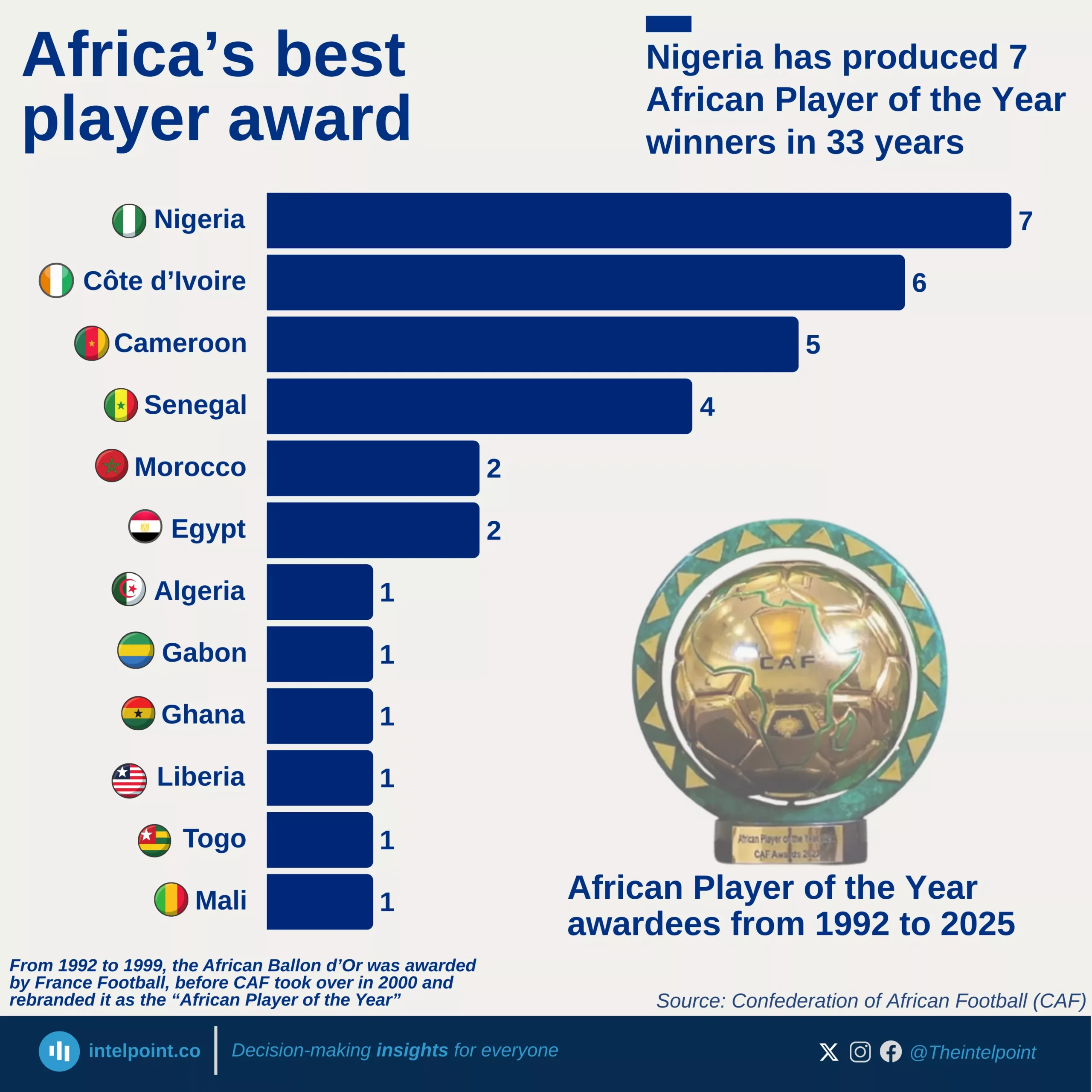
Image source: Intelpoint
Every African Player of the Year Winner From 1970 to Present
The following table provides a historical record of the men's award winners. It is important to note that from 1970 to 1994, the award was presented by the French magazine France Football. In 1992, the Confederation of African Football (CAF) introduced its own official award. For the three years where the awards overlapped (1992-1994), both winners are historically recognized, though the CAF award is considered the official continuation.
| Year | Player | Nationality | Club at Time of Award |
|---|---|---|---|
| 2025 | Achraf Hakimi | Morocco | Paris Saint-Germain |
| 2024 | Ademola Lookman | Nigeria | Atalanta |
| 2023 | Victor Osimhen | Nigeria | Napoli |
| 2022 | Sadio Mané | Senegal | Bayern Munich |
| 2020-2021 | Not Awarded | N/A | COVID-19 Pandemic |
| 2019 | Sadio Mané | Senegal | Liverpool |
| 2018 | Mohamed Salah | Egypt | Liverpool |
| 2017 | Mohamed Salah | Egypt | Liverpool |
| 2016 | Riyad Mahrez | Algeria | Leicester City |
| 2015 | Pierre-Emerick Aubameyang | Gabon | Borussia Dortmund |
| 2014 | Yaya Touré | Ivory Coast | Manchester City |
| 2013 | Yaya Touré | Ivory Coast | Manchester City |
| 2012 | Yaya Touré | Ivory Coast | Manchester City |
| 2011 | Yaya Touré | Ivory Coast | Manchester City |
| 2010 | Samuel Eto'o | Cameroon | Inter Milan |
| 2009 | Didier Drogba | Ivory Coast | Chelsea |
| 2008 | Emmanuel Adebayor | Togo | Arsenal |
| 2007 | Frédéric Kanouté | Mali | Sevilla |
| 2006 | Didier Drogba | Ivory Coast | Chelsea |
| 2005 | Samuel Eto'o | Cameroon | Barcelona |
| 2004 | Samuel Eto'o | Cameroon | Barcelona |
| 2003 | Samuel Eto'o | Cameroon | Mallorca / Barcelona |
| 1998 | Mustapha Hadji | Morocco | Deportivo La Coruña |
| 1995 | George Weah | Liberia | AC Milan |
| 1992 | Abedi Pele (FF) / Rashidi Yekini (CAF) | Ghana / Nigeria | Marseille / Vitória de Setúbal |
| 1982 | Thomas N'Kono | Cameroon | Espanyol |
| 1973 | Bwanga Tshimen | Zaire | TP Mazembe |
| 1970 | Salif Keïta | Mali | Saint-Étienne |
Note: This table highlights notable winners across different eras. For the exhaustive year-by-year breakdown including all voting margins, refer to the official historical records.
Which Players Have Won the Most African Player of the Year Awards?
Achieving this honor once is a career-defining moment, but a select few players have managed to sustain their dominance over multiple seasons. In the men's game, the record for the most wins is shared by two players who defined African football in the 21st century: Samuel Eto'o and Yaya Touré.
The 4-Win Club: Eto'o and Touré
Cameroonian striker Samuel Eto'o claimed the award four times 2003 2004 2005 2010. His first three awards came during his prolific rise in Spain, transitioning from Mallorca to becoming a central figure in Barcelona's attack. His final award in 2010 was secured after he played a crucial tactical role in Inter Milan's historic treble-winning season under José Mourinho.
Ivorian midfielder Yaya Touré also holds four awards, but his achievement is notable for its consecutive nature. Touré won the award every year from 2011 to 2014. During this period, he was the driving force behind Manchester City's emergence as a dominant power in the English Premier League. His 2013-2014 season, where he scored 20 league goals from central midfield, is widely regarded as one of the top individual campaigns by an African player in European football history.
The "Double-Double" Club
Another fascinating statistical niche is the "Double-Double" club—players who have won both the CAF Youth Player of the Year and the senior African Player of the Year during their careers. This progression indicates a player who fulfilled their early potential.
- Victor Osimhen: Won the Youth award in 2015 after a record-breaking U-17 World Cup, and later secured the senior award in 2023 following his Serie A-winning season with Napoli.
- Achraf Hakimi: Claimed the Youth award in consecutive years (2018, 2019) before winning the senior honor in 2025.
Why Achraf Hakimi’s 2025 Win Ended a 52-Year Drought for Defenders
Individual football awards have historically favored attacking players. Goalscorers and creative midfielders generate the most visible highlights, which often translates to more votes from national team coaches and media representatives. This bias makes Achraf Hakimi's 2025 victory particularly significant from a historical perspective.
Before Hakimi, the last time a primary defender won the African Player of the Year award was in 1973, when Zaire's Bwanga Tshimen took home the honor. Tshimen, a commanding center-back, was instrumental in Zaire's (now DR Congo) dominance in African football during that era, leading them to an Africa Cup of Nations title and World Cup qualification.
"Hakimi's 2025 win broke a 52-year drought for defenders, highlighting a shift in how modern football evaluates the tactical importance of fullbacks."
The 52-year gap underscores how difficult it is for defensive players to gain recognition. Hakimi managed to bridge this gap because the modern full-back role has evolved dramatically. At Paris Saint-Germain, Hakimi operates almost as a right-sided playmaker. During his 2025 award-winning campaign, his underlying metrics showed elite ball progression, high assist numbers, and crucial goals in the UEFA Champions League, allowing voters to view him as an offensive asset as much as a defensive one.
How the Award Shifted From France Football to the CAF Era
Understanding the history of the African Player of the Year requires navigating a slightly complex timeline involving two different awarding bodies. The award was not originally created by the continent's football governing body.
From 1970 to 1994, the award was organized and presented by France Football magazine—the same publication responsible for the Ballon d'Or. During this era, the award was often referred to as the African Ballon d'Or. The inaugural winner was Mali's Salif Keïta, who was recognized for his exceptional goalscoring record with French club Saint-Étienne.
In 1992, the Confederation of African Football (CAF) decided to launch its own official award. However, France Football continued to hand out its version until 1994. This created a three-year period where two different players could claim to be the African Player of the Year.
- 1992: Abedi Pele won the France Football award; Rashidi Yekini won the CAF award.
- 1993: Abedi Pele won both awards.
- 1994: George Weah won the France Football award; Emmanuel Amuneke won the CAF award.
Today, CAF's official history recognizes the winners of both awards during this transitional period, though the CAF lineage is the one that continues to this day.
The Only Goalkeeper to Win Twice
Just as defenders struggle to win individual awards, goalkeepers face an even steeper uphill battle. In the entire history of the award, only one goalkeeper has ever won the main prize: Cameroon's Thomas N'Kono. Remarkably, N'Kono won it twice, in 1979 and 1982. His performances for Canon Yaoundé and later Espanyol set a high standard for African goalkeeping, heavily influencing future generations (including inspiring a young Gianluigi Buffon in Italy).
The Rise of European-Born Stars in African Football
A noticeable demographic shift has occurred in the winners' list over the past two decades. Historically, the award was won by players born and raised on the African continent who later moved to Europe. However, changes in FIFA eligibility rules and the growth of the African diaspora in Europe have led to a rise in European-born winners.
The turning point occurred in 2007 when Frédéric Kanouté won the award. Born in France, Kanouté represented the French national team at the U-21 level before switching his allegiance to Mali, his father's home country. He became the first European-born player to win the African Player of the Year.
Since then, this trend has accelerated. Several recent winners were born and developed in European academy systems before choosing to represent African nations:
- Riyad Mahrez (2016): Born in France, represents Algeria.
- Pierre-Emerick Aubameyang (2015): Born in France, represents Gabon.
- Ademola Lookman (2024): Born in England, represented England at youth levels before switching to Nigeria.
- Achraf Hakimi (2025): Born in Spain, developed at Real Madrid's academy, represents Morocco.
This shift highlights the globalized nature of modern football and the success African federations have had in recruiting dual-national talent to strengthen their national teams.
Asisat Oshoala and the Most Dominant Winners in Women’s Football
While the men's award dates back to 1970, the CAF Women's African Player of the Year was introduced in 2001. Despite its shorter history, it has produced the most statistically dominant player across any category of African football.
Nigerian forward Asisat Oshoala has won the award a record six times (2014, 2016, 2017, 2019, 2022, 2023). Her dominance spans multiple clubs, including Liverpool, Arsenal, and Barcelona, where she became the first African woman to win the UEFA Women's Champions League. Oshoala's six victories place her ahead of Eto'o and Touré in terms of sheer volume of continental recognition.
Beyond Oshoala, the women's awards have highlighted remarkable consistency in other positions. Nigerian goalkeeper Chiamaka Nnadozie established a strong reputation by winning the specialized Women's Goalkeeper of the Year award for three successive years (2023, 2024, 2025), a level of positional dominance rarely seen in CAF voting history.
The "Runner-Up Curse" and the Players Who Almost Won
Voting for the African Player of the Year is conducted by a panel that includes CAF technical committee members, media professionals, and head coaches/captains of member associations. Because it is a points-based voting system, several legendary players have consistently finished on the podium without securing the record number of wins their talent might suggest.
The most prominent example of this is Ivory Coast's Didier Drogba. While Drogba won the award twice (2006, 2009), his overall voting record is staggering. He holds the record for the most top-three finishes in the history of the award, appearing on the podium nine times. Furthermore, he finished as the runner-up on four separate occasions. During the late 2000s, the voting frequently came down to razor-thin margins between Drogba and Eto'o.
Close voting margins have always been a part of the award's drama. For instance, in 1983, Egyptian legend Mahmoud El Khatib won the award with 98 points, narrowly edging out Ghana's Opoku Nti, who finished with 89 points. These tight races often reflect the difficulty voters face when comparing a player who achieved international success (like winning the AFCON) against a player who had a dominant domestic season in a top European league.
Which Countries and Clubs Have Produced the Most Winners?
Analyzing the winners by nationality reveals clear regional powerhouses in African football. West and Central African nations have historically dominated the men's award.
- Cameroon: Boosted heavily by Samuel Eto'o's four wins, Roger Milla's two wins, and Thomas N'Kono's two wins, Cameroon ranks among the top nations for total awards.
- Nigeria: Nigeria boasts a wide distribution of winners, including Rashidi Yekini, Emmanuel Amuneke, Nwankwo Kanu, Victor Ikpeba, Victor Osimhen, and Ademola Lookman.
- Ivory Coast: Driven almost entirely by the golden generation of Yaya Touré and Didier Drogba.
Recently, North Africa has seen a surge in recognition. The 2025 CAF Awards were particularly notable for a Moroccan sweep. Morocco secured the Men's Player of the Year (Hakimi), the Women's Player of the Year (Chebbak), and the Youth Player of the Year awards, reflecting heavy investment in the country's football infrastructure following their historic 2022 World Cup semi-final run.
Inter-Club Dominance: The Al Ahly Monopoly
In 2005, CAF introduced the "African Inter-Club Player of the Year" award, specifically designed to honor players who ply their trade within African domestic leagues, rather than in Europe. This category has been overwhelmingly dominated by one club: Egypt's Al Ahly.
Players like Mohamed Aboutrika (who won the inter-club award four times) and Mohamed Barakat established Al Ahly as the premier destination for domestic talent. More recently, South African forward Percy Tau claimed the inter-club honor while playing for the Egyptian giants, further cementing the club's status as a top-tier option for players remaining on the continent.
Frequently Asked Questions
Who has won the African Player of the Year the most times?
Has a goalkeeper ever won the African Player of the Year?
Who is the current African Footballer of the Year?
Why were there no awards given in 2020 and 2021?
What is the difference between the CAF award and the BBC award?
Final Thoughts on the Legacy of African Football Excellence
The history of the African Player of the Year award is a testament to the continent's enduring influence on global football. From the early days of domestic legends to modern superstars leading European clubs to Champions League glory, the award tracks the tactical and demographic evolution of the sport.
- Record Holders: Samuel Eto'o and Yaya Touré lead the men with 4 wins each, while Asisat Oshoala leads the women with 6 wins.
- Historical Shift: The award transitioned from France Football magazine to official CAF administration in 1992.
- Defensive Milestone: Achraf Hakimi's 2025 victory ended a 52-year drought for defenders winning the main award.
- Demographic Changes: There is a growing trend of European-born dual-nationals (like Lookman and Hakimi) claiming the honor.
- National Dominance: Nigeria and Cameroon remain historical powerhouses, though Morocco has recently surged in both men's and women's categories.